
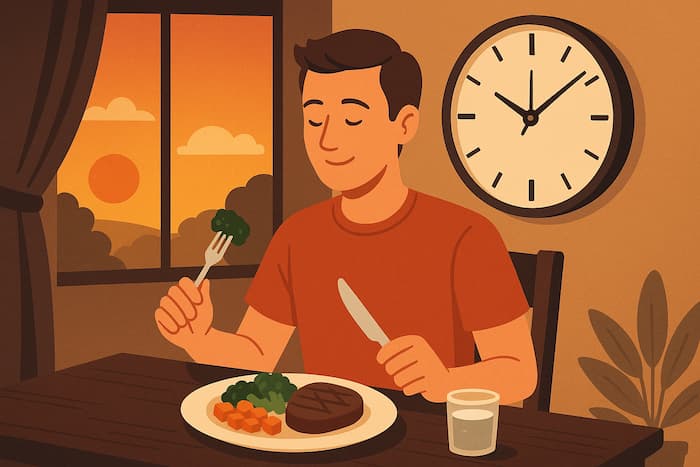
You’ve heard the saying, “Eat like a king in the morning, a prince at noon, and a pauper by evening.” Turns out, modern science and ancient Ayurveda both nod in agreement—just from different angles.
When you shift your last meal earlier, you align your eating window with your circadian rhythm (your body’s internal clock). That sync leads to better metabolism, improved insulin sensitivity, and a higher chance of burning fat instead of storing it.
Let’s dive into the how and why.
The Science: Timing Matters
1. Circadian Rhythm & Metabolic Health
Your body’s metabolic processes—insulin release, fat oxidation, glucose tolerance—follow a daily rhythm. Eating late disrupts this natural cycle, making your body less efficient at processing nutrients. Studies show that such disruption is linked to weight gain, metabolic syndrome, and poor glycemic control.
In “Circadian rhythms and meal timing: impact on energy metabolism and cardiovascular health”, researchers explain how misaligned feeding (like eating late at night) can worsen metabolic outcomes.
2. Early Time-Restricted Feeding (eTRF): Real Trials, Real Results
A landmark study by Sutton et al. (2018) tested an early time-restricted feeding schedule (eating between 8 AM and 2 PM) and found improvements in insulin sensitivity, blood pressure, and oxidative stress—even without significant weight loss.
Another randomized trial published in JAMA Internal Medicine (Jamshed et al.) compared early time-restricted eating to a standard 12-hour eating window. The early-eating group lost more weight, burned more fat, and had better blood pressure and mood.
A 2024 meta-analysis, “Meal Timing and Anthropometric and Metabolic Outcomes”, also found that earlier dinners were associated with improved weight, glucose, and lipid profiles compared to later eating patterns.
Numbers to Note:
- In the Jamshed trial, participants on the early schedule lost more total and fat mass than the control group.
- The Sutton study showed better insulin sensitivity and reduced oxidative stress without weight loss, meaning early eating benefits go beyond calorie burn.
3. Long Overnight Fast & Metabolic “Rest”
Eating dinner earlier extends your natural overnight fasting window. This pushes your body to switch into fat-burning mode (fat oxidation) rather than relying on glucose from recent meals.
How Early Is “Early Dinner”?
“Early” doesn’t mean extreme. It means aligning your meals with daylight and your sleep schedule.
Guidelines:
- Finish dinner 2.5–3 hours before bedtime (e.g., by 7 PM if you sleep at 10–10:30 PM).
- Ideally, finish between 6–7 PM if your schedule allows.
- Keep your last meal light and easy to digest—lean protein, vegetables, and minimal fats.
Why Early Dinner Helps With Weight Loss
| Mechanism | How It Supports Weight Loss | |------------|-----------------------------| | Improved insulin sensitivity | Late meals spike insulin when your body is less responsive → more fat storage. Early meals are better tolerated. | | Longer fasting window | Encourages fat use as energy source, reduces insulin “on” time. | | Reduced late-night snacking | Fewer chances for calorie-dense, mindless eating. | | Better hormonal alignment | Ghrelin, leptin, and cortisol synchronize better with consistent meal timing. | | Lower digestive stress | Early, lighter dinners improve digestion before sleep. |
Eating early also reduces “post-dinner overconsumption”—that “just one more bite” tendency that strikes late at night when willpower dips.
Practical Tips to Adopt Early Dinner
- Gradually shift timings – Move dinner earlier by 15–30 minutes every few days.
- Keep it light but filling – Use lean proteins (chicken, paneer, legumes) with fibrous veggies and complex carbs.
- Avoid evening traps – Replace the “chai + biscuit” combo with herbal teas like tulsi or ginger.
- Distribute calories smartly – Front-load calories earlier in the day to prevent hunger at night.
- Stay consistent – Your body thrives on predictable rhythms.
- Support digestion – In Ayurveda, sipping warm water or herbs like cumin, fennel, or ginger post-dinner helps.
Cautions & Caveats
- Early dinner isn’t magic—you still need calorie control, balanced nutrition, and exercise.
- Not ideal for night-shift workers (their circadian rhythm differs).
- Diabetics or people with gastric issues should consult professionals before making drastic changes.
- Pairing tight eating windows with intense workouts may lead to low energy if calories are insufficient.
Reference Links
- https://pmc.ncbi.nlm.nih.gov/articles/PMC7182033/?
- https://pubmed.ncbi.nlm.nih.gov/32998085/
- https://jamanetwork.com/journals/jamainternalmedicine/fullarticle/2794819