
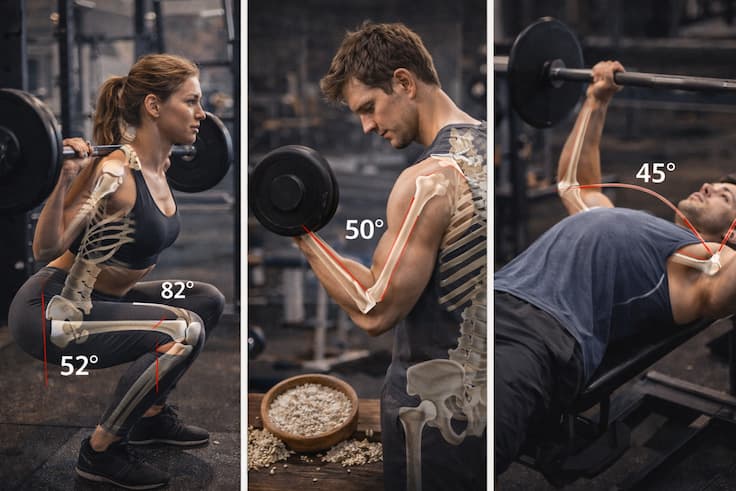
If you have ever exercised in a gym for more than a month, you have heard it. Do not squat like that. Your elbows are wrong. Your back angle is unsafe. Someone will always tell you that the way you are moving is incorrect.
Here is the uncomfortable truth. Gym technique has evolved, but it has also become over-policed. Earlier generations lifted heavy with fewer rules. Modern training focuses more on angles, cues, and joint safety. Both eras got some things right, and both misunderstood others.
The real question is not whether there is one correct angle. The question is which principles matter and which ones are flexible.
Why Exercise Angles Matter
Joint angles determine how force is distributed across muscles, tendons, and joints. Changing an angle can shift load from one muscle group to another or change stress on connective tissue.
That said, human bodies are not identical machines. Bone structure, limb length, joint mobility, injury history, and training goals all influence what feels and performs best.
There is no single universal form. There are ranges that are safer and more effective for most people.
Old-School Training vs Modern Technique
Earlier gym culture emphasized lifting heavy with minimal technical breakdown. Many people built strength that way, but injury rates were higher and long-term joint health was often ignored.
Modern training emphasizes joint alignment, controlled tempo, and range of motion. This improves safety and muscle targeting but can sometimes create unnecessary fear around natural movement variability.
The right approach sits between these extremes.
Key Exercises and What Actually Matters
Squats
Common argument: how deep is deep enough and how upright should the torso be.
Research shows that squatting to a depth where the hip crease is at or below knee level increases muscle activation without increasing knee injury risk in healthy individuals.
Torso angle varies based on anatomy. Longer femurs lead to more forward lean. This is not wrong if the spine remains neutral.
What matters:
- Neutral spine under load
- Knees tracking in line with toes
- Depth that can be controlled
What is flexible:
- Foot angle
- Stance width
- Torso inclination
Deadlifts
Common argument: flat back versus rounded back.
A neutral spine under heavy load reduces injury risk. However, slight spinal flexion under lighter loads is not inherently dangerous if controlled and intentional.
Hip hinge mechanics matter more than textbook posture.
What matters:
- Load close to the body
- Bracing the core
- Controlled hip hinge
What is flexible:
- Grip width
- Foot position
- Conventional versus sumo style
Bench Press
Common argument: elbow flare and bar path.
Moderate elbow flare allows better chest activation while extreme flaring increases shoulder stress. The safest bar path is slightly diagonal, not straight up and down.
What matters:
- Shoulder blades retracted and stable
- Wrists stacked over elbows
- Controlled lowering
What is flexible:
- Grip width
- Degree of elbow flare
Overhead Press
Common argument: straight bar path versus arcing path.
A slight arc around the face is biomechanically efficient and reduces shoulder stress. Forcing a perfectly vertical path often creates unnecessary joint strain.
What matters:
- Core bracing
- Neutral spine
- Pain-free shoulder range
What is flexible:
- Stance width
- Grip width
Rows and Pulling Movements
Common argument: strict form versus body movement.
Some momentum is acceptable depending on goal. Strict rows maximize muscle isolation, while controlled body movement allows heavier loading.
What matters:
- Spine stability
- Shoulder control
- Smooth pulling motion
What is flexible:
- Torso angle
- Row style
Why People Say Form Is Wrong
Most corrections come from one of three places:
- Someone repeating cues without understanding anatomy
- Someone applying their body mechanics to yours
- Someone confusing optimal with acceptable
Optimal form maximizes muscle activation and efficiency. Acceptable form is safe, controlled, and effective. Most people live comfortably in acceptable form and still make excellent progress.
How to Choose the Right Form for You
1. Start With Joint Comfort
Pain is not a technique cue. If a movement consistently hurts joints, adjust stance, range, or load.
2. Control the Load First
If form only breaks when weight increases, the weight is the issue, not your body.
3. Respect Your Anatomy
Long limbs, limited ankle mobility, or previous injuries will change angles. This is normal.
4. Focus on Outcomes, Not Aesthetics
Good form produces strength, control, and repeatable performance. It does not need to look identical across individuals.
5. Avoid Technique Absolutism
Anyone who claims there is only one correct way to move is oversimplifying biomechanics.
The Bottom Line
Exercise technique has evolved for good reasons, but movement is not a checklist. Angles matter, but context matters more.
The right way to exercise is the way that allows you to train consistently, safely, and progressively over time. If a movement is controlled, pain-free, and repeatable, you are likely doing it right, even if it does not look like someone else’s version.
Your body is not wrong. It just has its own geometry.