
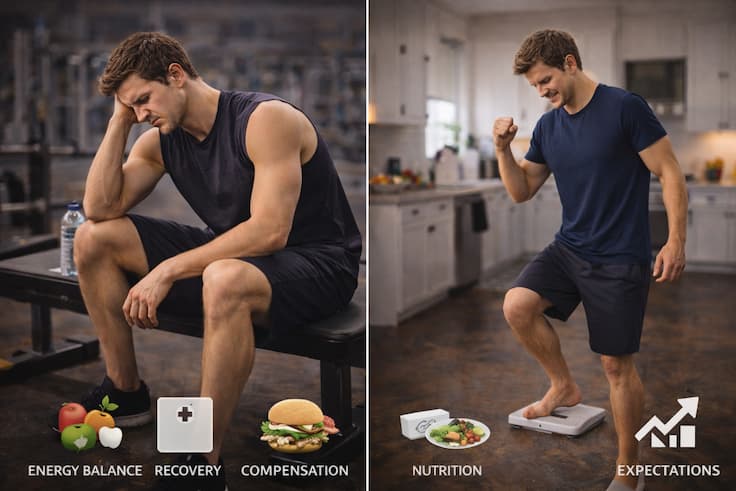
You joined the gym. You show up. You sweat. And yet, nothing changes the way you expected.
This is usually where people start questioning the gym, their metabolism, or their genetics. In reality, the gym is rarely the problem. Expectations and missing pieces usually are.
Fat loss is not triggered by effort alone. It responds to energy balance, recovery, and behavior outside the gym just as much as what happens inside it.
The Gym Is Only One Hour of Your Day
Most people train for forty-five to sixty minutes. The remaining twenty-three hours quietly decide the outcome.
Research shows that total daily energy balance is driven more by what you eat, how much you move outside workouts, and how well you recover than by training sessions alone.
The gym helps. It does not override everything else.
You May Be Eating More Than You Think
Exercise often increases appetite.
People tend to compensate unconsciously after workouts by eating larger portions, adding snacks, or choosing higher-calorie foods because they feel they have earned it.
Studies consistently show that calorie compensation after exercise can partially or completely offset the calories burned during training.
Cardio Alone Is Often Overestimated
Cardio burns calories, but the numbers are often exaggerated.
A typical cardio session may burn fewer calories than expected, especially as fitness improves. Meanwhile, hunger increases and daily movement outside the gym may decrease due to fatigue.
This creates a neutral or minimal deficit, even with regular gym attendance.
Strength Training Without Nutrition Support
Strength training improves body composition, but it does not automatically lead to fat loss.
Without a calorie deficit and adequate protein intake, strength training may improve fitness while body fat remains unchanged.
This is not failure. It is physiology.
Recovery and Sleep Are Underrated Fat-Loss Tools
Poor sleep increases hunger hormones, reduces insulin sensitivity, and raises stress hormones.
Research shows that sleep-deprived individuals lose less fat and more muscle during weight loss attempts, even with the same calorie intake.
Training harder does not compensate for chronic sleep loss.
Stress Can Stall Progress
High stress increases cortisol, which can affect appetite, recovery, and fat distribution.
Stress also reduces adherence. Missed workouts, emotional eating, and poor sleep tend to cluster together.
Fat loss becomes harder not because you are weak, but because your system is overloaded.
Why the Scale May Be Misleading
Strength training can increase muscle mass while fat loss occurs slowly.
The scale may stay stable even as body composition improves. This often leads people to abandon effective programs prematurely.
Measurements, progress photos, and how clothes fit provide better feedback than weight alone.
What Actually Works
1. Align Training With Nutrition
Exercise supports fat loss. Diet drives it.
You do not need extreme restriction. You need a consistent, moderate calorie deficit with sufficient protein.
2. Increase Daily Movement
Walking, standing, and light activity contribute significantly to energy expenditure.
Daily movement often matters more than adding extra gym sessions.
3. Prioritize Sleep and Recovery
Seven to nine hours of quality sleep improves fat loss outcomes and training performance.
4. Strength Train to Protect Muscle
Maintaining muscle improves body composition and long-term metabolic health.
5. Be Patient With the Process
Fat loss happens over weeks and months, not days.
Short-term plateaus are normal. Consistency beats constant program changes.
The Bottom Line
The gym is not failing you. It is doing its part.
Fat loss works when training, nutrition, recovery, and lifestyle point in the same direction. When one piece is missing, effort alone cannot force results.
Fix the system, not the motivation.