
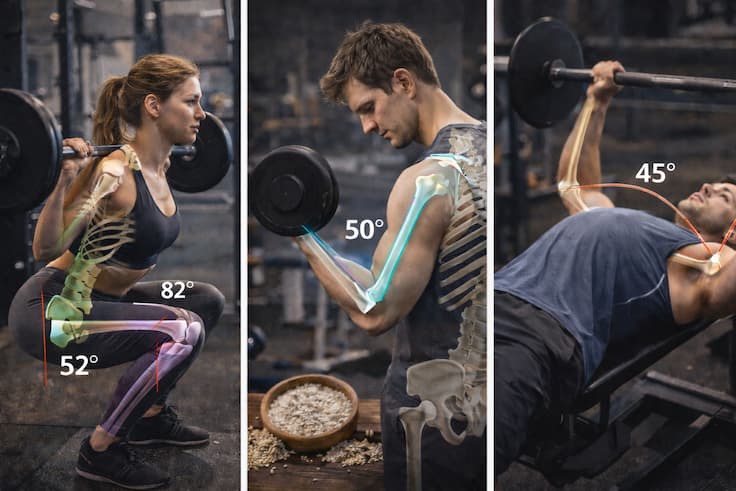
If exercise form had comment sections, they would be chaos. Everyone has an opinion, most are loud, and very few explain context. The result is confusion. People stop trusting their bodies and start chasing perfect angles that may not even suit them.
This follow-up breaks things down exercise by exercise. Not to create more rules, but to clarify which angles actually matter, which ones are adaptable, and how to decide what is right for you.
Important reminder before we begin. These are evidence-based ranges, not rigid commandments. Pain-free, controlled movement always wins.
Squat (Back Squat or Goblet Squat)
| Aspect | Recommended Range | Why It Matters | What Can Vary | |------|------------------|----------------|--------------| | Torso angle | Neutral spine with forward lean | Protects spine and transfers force efficiently | Degree of lean depends on femur length | | Knee angle | Knees track over toes | Reduces knee stress and improves stability | Slight inward movement under load is normal | | Hip depth | Hip crease at or below knee | Improves muscle activation | Depth depends on mobility and comfort | | Foot angle | Slightly turned out | Improves hip mechanics | Angle varies by hip structure |
Who should adjust: People with long femurs, ankle mobility limits, or previous knee issues.
Deadlift (Conventional or Sumo)
| Aspect | Recommended Range | Why It Matters | What Can Vary | |------|------------------|----------------|--------------| | Spine position | Neutral under heavy load | Reduces injury risk | Mild flexion under light loads | | Hip hinge angle | Hips back, chest over bar | Engages posterior chain | Start position varies by limb length | | Bar path | Close to shins and thighs | Reduces spinal torque | Exact contact points | | Foot stance | Hip to shoulder width | Optimizes force transfer | Sumo vs conventional |
Who should adjust: People with long arms often start higher. Short arms require deeper hip positions.
Bench Press
| Aspect | Recommended Range | Why It Matters | What Can Vary | |------|------------------|----------------|--------------| | Elbow angle | About 45 to 75 degrees from torso | Protects shoulders | Powerlifters may flare more | | Bar path | Slight diagonal toward shoulders | Matches shoulder mechanics | Exact path | | Wrist alignment | Stacked over elbows | Reduces joint strain | Grip width | | Shoulder position | Retracted and stable | Improves chest activation | Degree of arch |
Who should adjust: People with shoulder pain should reduce flare and grip width.
Overhead Shoulder Press
| Aspect | Recommended Range | Why It Matters | What Can Vary | |------|------------------|----------------|--------------| | Bar path | Slight arc around face | Reduces shoulder stress | Degree of arc | | Rib position | Ribs down, core braced | Protects lower back | Natural spinal curve | | Elbow position | Slightly in front of bar | Improves force output | Grip width | | Head movement | Head moves back then through | Keeps bar balanced | Timing |
Who should adjust: Limited shoulder mobility requires dumbbells or landmine presses.
Pull-Ups and Lat Pulldowns
| Aspect | Recommended Range | Why It Matters | What Can Vary | |------|------------------|----------------|--------------| | Scapular movement | Down and back | Protects shoulders | Range of motion | | Elbow path | Toward ribs | Targets lats effectively | Grip type | | Neck position | Neutral | Reduces strain | Chin position | | Range of motion | Chest toward bar | Maximizes muscle use | Partial reps for beginners |
Who should adjust: Beginners may use assisted variations to maintain control.
Bent-Over Rows
| Aspect | Recommended Range | Why It Matters | What Can Vary | |------|------------------|----------------|--------------| | Torso angle | 30 to 45 degrees forward | Balances load and stability | Row style | | Spine position | Neutral | Reduces lower-back stress | Upper-back rounding | | Elbow path | Pull toward hips | Improves lat engagement | Grip width | | Momentum | Minimal to controlled | Prevents cheating | Body English for advanced lifters |
Who should adjust: Lower-back issues may benefit from chest-supported rows.
Lunges and Split Squats
| Aspect | Recommended Range | Why It Matters | What Can Vary | |------|------------------|----------------|--------------| | Front knee | Tracks over toes | Protects knee joint | Slight forward travel | | Torso angle | Slight forward lean | Improves glute activation | Degree of lean | | Stride length | Comfortable and stable | Reduces joint stress | Short vs long stride | | Hip depth | Controlled descent | Improves strength | Depth |
Who should adjust: Balance issues benefit from split squats before walking lunges.
Planks and Core Bracing
| Aspect | Recommended Range | Why It Matters | What Can Vary | |------|------------------|----------------|--------------| | Spine | Neutral | Protects lower back | Slight pelvic tilt | | Shoulder position | Over elbows | Reduces shoulder strain | Hand position | | Hip position | In line with torso | Maximizes core engagement | Height based on strength | | Breathing | Controlled, nasal if possible | Improves core control | Breathing rhythm |
Who should adjust: Lower-back discomfort means raising hands or knees.
How to Use These Tables Correctly
These tables are guides, not verdicts. Use them to identify safe ranges, not to chase visual perfection.
Ask yourself three questions:
- Is the movement controlled
- Is it pain-free
- Can I repeat it consistently
If the answer is yes, your angles are likely working for you.
The Bottom Line
Gym technique has evolved because we know more about joints, muscles, and injury prevention. But movement is still individual.
There is no single correct angle for everyone. There are safe zones, adaptable ranges, and personal variations.
Train inside those ranges, respect your anatomy, and stop letting random opinions rewrite your form mid-set.