
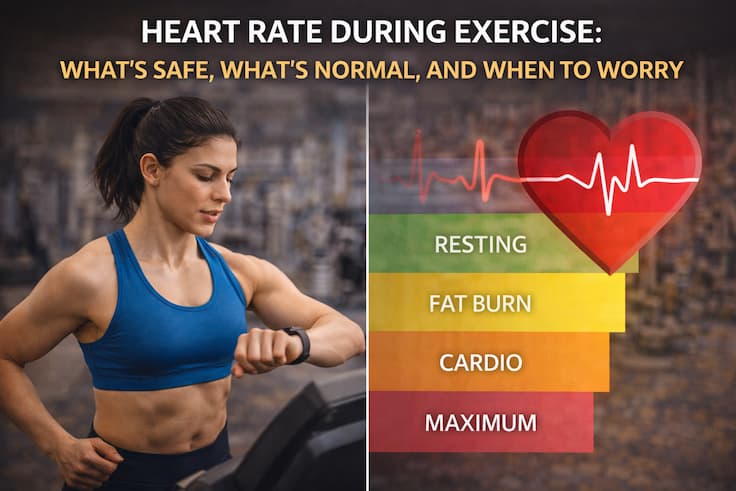
At some point during exercise, almost everyone looks at their watch and thinks, that number feels high. Heart rate monitors are useful tools, but without context they can create unnecessary fear.
The goal of heart rate tracking is not to stay calm at all times or push to extremes. It is to understand how your body responds to effort and when it needs adjustment.
What Heart Rate Actually Measures
Heart rate reflects how hard your cardiovascular system is working to deliver oxygen to your muscles.
As exercise intensity increases, heart rate rises to meet demand. This response is normal and necessary.
Problems arise not from heart rate going up, but from misunderstanding what different ranges mean.
Understanding Heart Rate Zones
Heart rate zones are typically expressed as percentages of your estimated maximum heart rate.
A commonly used estimate for maximum heart rate is 220 minus age. This is an approximation, not a medical diagnosis.
Zone 1: Very Light Intensity (50 to 60 percent)
This zone supports recovery, warm-ups, and general movement. You should be able to talk comfortably.
Zone 2: Light to Moderate Intensity (60 to 70 percent)
This zone improves aerobic efficiency and endurance. Breathing deepens but conversation remains possible.
Zone 3: Moderate to Hard Intensity (70 to 80 percent)
This zone improves cardiovascular fitness. Talking becomes difficult. This is normal during sustained effort.
Zone 4: Hard Intensity (80 to 90 percent)
Used in intervals and performance training. Effort is high and sustainable only for short periods.
Zone 5: Very Hard Intensity (90 percent and above)
Maximal effort territory. Used briefly by trained individuals. Not required for general health.
What Is Considered Safe
For healthy individuals without cardiovascular conditions, exercising across Zones 1 to 4 is generally safe when progressed gradually.
Short exposures to higher heart rates during intervals are normal for trained individuals.
Heart rate alone does not determine safety. Symptoms matter more than numbers.
When to Slow Down or Stop
Stop or reduce intensity if you experience:
- Chest pain or pressure
- Dizziness or fainting
- Unusual shortness of breath
- Irregular heartbeat sensation
These are not training challenges. They are medical signals.
Why Heart Rate Feels High on Some Days
Heart rate is influenced by more than exercise intensity.
Common factors include:
- Poor sleep
- Dehydration
- Heat and humidity
- Stress and anxiety
- Caffeine
A higher heart rate does not always mean poorer fitness. Context matters.
Fitness Level Changes the Interpretation
As fitness improves, heart rate at a given workload often decreases.
However, day-to-day fluctuations are normal. Progress is seen in long-term trends, not single sessions.
Should Beginners Use Heart Rate Monitors
Heart rate monitors can be helpful, but they are not mandatory.
Beginners often benefit more from perceived effort cues such as breathing rate and ability to talk.
Technology should support awareness, not replace it.
Special Considerations
People with known heart conditions, hypertension, or those on heart rate–altering medications should consult healthcare professionals before using heart rate zones aggressively.
This article does not replace medical advice.
The Bottom Line
Heart rate rising during exercise is normal. It is a sign that your body is responding appropriately to demand.
Use heart rate as a guide, not a rulebook. Combine numbers with how you feel, how you recover, and how your performance trends over time.
Your heart is built to work. Understanding it helps you train with confidence rather than fear.