
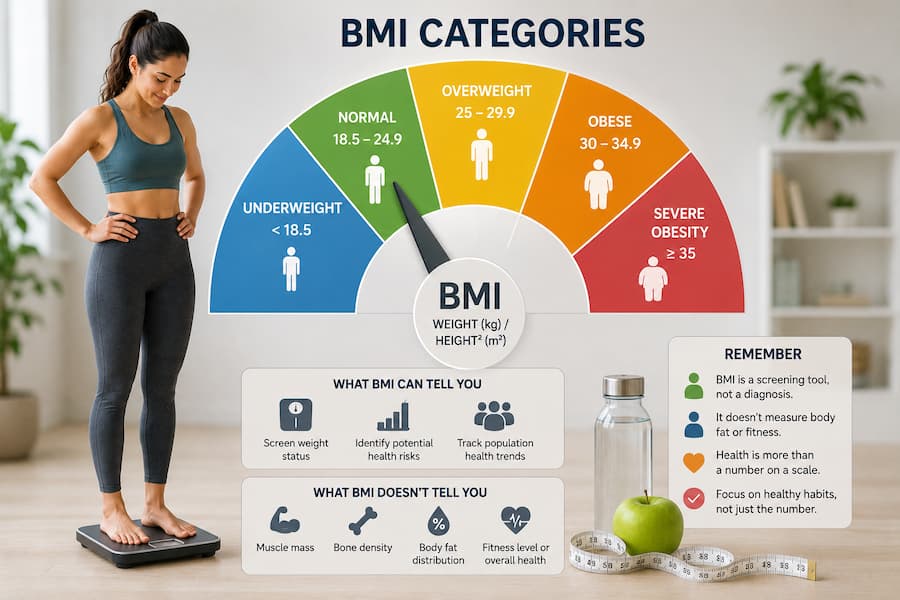
Few health numbers create more confusion online than BMI.
Some people treat it like a medical truth carved into stone tablets. Others dismiss it entirely because a muscular athlete technically falls into the “overweight” category. Somewhere between those extremes is the reality most people actually need.
BMI, or Body Mass Index, is a screening tool. Not a personality test. Not a complete diagnosis. And definitely not a full summary of someone’s health, fitness, or lifestyle.
Still, despite its limitations, BMI continues to be widely used because it offers a quick way to estimate whether body weight may be associated with increased health risk at a population level.
What BMI Actually Measures
BMI is calculated using height and weight.
The formula itself is simple, which is partly why it became so widely adopted in healthcare settings.
For adults, BMI is generally categorized as:
- Underweight: Below 18.5
- Healthy range: 18.5 to 24.9
- Overweight: 25 to 29.9
- Obesity: 30 and above
The number is meant to act as an initial screening indicator, not a final judgment.
That distinction matters.
Because the body is far more complex than a mathematical ratio.
Why BMI Became Popular
Healthcare systems needed a simple, inexpensive way to identify broad patterns linked to body weight and disease risk.
At a large population level, higher BMI ranges are associated with increased risk of conditions such as:
- Type 2 diabetes
- High blood pressure
- Sleep apnea
- Cardiovascular disease
- Joint strain
That does not mean every individual with a higher BMI is unhealthy.
It means risk trends tend to increase statistically across large groups.
Those are two very different conversations, although the internet often blends them together into one loud argument.
The Biggest Limitation of BMI
BMI does not directly measure:
- Body fat percentage
- Muscle mass
- Fat distribution
- Fitness levels
- Metabolic health
- Bone density
This is why two people with identical BMI values may have very different health profiles.
For example, someone who strength trains regularly may carry more lean muscle mass and weigh more despite having relatively low body fat.
On the other hand, someone with a “normal” BMI may still have poor metabolic health, low muscle mass, high visceral fat, poor sleep, and low physical activity.
Health is rarely explained by one number alone.
Why Waist Size Often Matters Too
One reason healthcare professionals sometimes look beyond BMI is because fat distribution matters.
Excess abdominal or visceral fat is more strongly associated with certain metabolic risks than body weight alone.
This is why waist circumference is often considered alongside:
- BMI
- Blood pressure
- Blood sugar markers
- Lipid profiles
- Lifestyle habits
The location of body fat can influence health outcomes differently.
Again, the body refuses to simplify itself just because online calculators would prefer it to.
BMI and Modern Fitness Culture
Social media has complicated the BMI conversation even further.
Some people become overly obsessed with staying inside a certain number range. Others reject all objective health markers entirely.
Neither extreme is particularly helpful.
A healthy lifestyle usually involves looking at the broader picture:
- Energy levels
- Mobility
- Sleep quality
- Strength
- Cardiovascular fitness
- Eating patterns
- Stress levels
- Blood markers
- Recovery
Someone can technically fall inside a “healthy” BMI category while still feeling exhausted, sedentary, sleep deprived, and metabolically unhealthy.
A number alone cannot fully describe how someone feels or functions.
BMI Can Still Be Useful When Used Correctly
Despite its flaws, BMI can still provide useful context in certain situations.
At a population level, it remains a practical screening tool because it is:
- Fast
- Accessible
- Inexpensive
- Easy to standardize
The problem usually begins when people treat BMI like a complete definition of personal health rather than one data point among many.
That is where nuance disappears.
And health conversations on the internet rarely suffer from a shortage of missing nuance.
The Goal Should Not Be Chasing a Number Alone
A lot of people emotionally attach themselves to BMI categories.
But sustainable health is usually less about reaching a mathematically perfect number and more about improving overall lifestyle patterns.
That may include:
- Building muscle strength
- Improving cardiovascular fitness
- Sleeping better
- Eating more balanced meals
- Reducing ultra-processed foods
- Managing stress
- Increasing daily movement
- Supporting long-term consistency
These habits often improve health markers even before dramatic weight changes happen.
What a “Healthy BMI” Really Means
A healthy BMI range may suggest that body weight falls within a range associated with lower statistical health risk for many people.
But it does not automatically guarantee:
- Optimal fitness
- Good nutrition
- Healthy hormones
- Strong mental health
- Good sleep
- High energy levels
And it certainly does not determine someone’s worth.
The healthiest approach is usually combining BMI with broader context instead of treating it like the final word on health.
HealthyHold Take
BMI is useful as a screening tool, but it was never designed to summarize the full complexity of human health.
The body is influenced by far more than height and weight alone.
Real health is usually reflected through consistent habits, physical function, recovery, metabolic health, and long-term lifestyle patterns rather than a single number on a chart.
Important Note
This article is intended for general health and wellness education only and should not be considered medical advice, diagnosis, or treatment. BMI is only one screening measure and may not accurately reflect individual health status in all cases. Consult a qualified healthcare professional for personalized evaluation and guidance regarding body composition, weight, and metabolic health.